
Boulder Retaining Walls for Traverse City Lakefront Homes


If you own a lakefront or sloped property in Traverse City or Northern Michigan, you already know the land is part of what makes the home special.
The views, the trees, the grade changes, the path down to the water, and the way the house sits into the landscape all matter.
But those same features can also make outdoor living more complicated.
A beautiful lakefront yard may have steep slopes, drainage challenges, uneven grades, limited flat space, or difficult transitions between the house, patio, pool, and shoreline. That is where a boulder retaining wall can make a major difference.
At Serene Stonescapes, we like boulder walls because they are both practical and beautiful. They can help shape the land, create usable outdoor spaces, manage grade changes, and still feel natural to the property.
For many homes around Traverse City, Old Mission Peninsula, Leelanau County, Suttons Bay, Glen Arbor, Leland, Northport, Torch Lake, Elk Rapids, and surrounding Northern Michigan communities, boulder retaining walls simply feel like they belong.
Why boulder retaining walls work so well in Northern Michigan
Northern Michigan has a very distinct landscape.
Lakefront lots, wooded hillsides, sandy soils, clay pockets, exposed slopes, and natural stone are all part of the character of the area. A retaining wall should not feel like a generic product forced onto the property.
Boulder walls work well because they look and feel connected to the land.
Instead of creating a hard, manufactured edge, boulders bring texture, weight, and natural variation. Each stone is different. The shape, color, size, and placement give the wall a more organic feel.
That natural quality is especially important on lakefront homes, where the goal is often to create structure without losing the feeling of the landscape.
A good boulder wall should feel substantial, but not out of place.
More than just holding back soil
A retaining wall is often thought of as a purely functional item.
And yes, boulder retaining walls can help hold grade and create stability when properly designed and installed.
But they can also do much more than that.
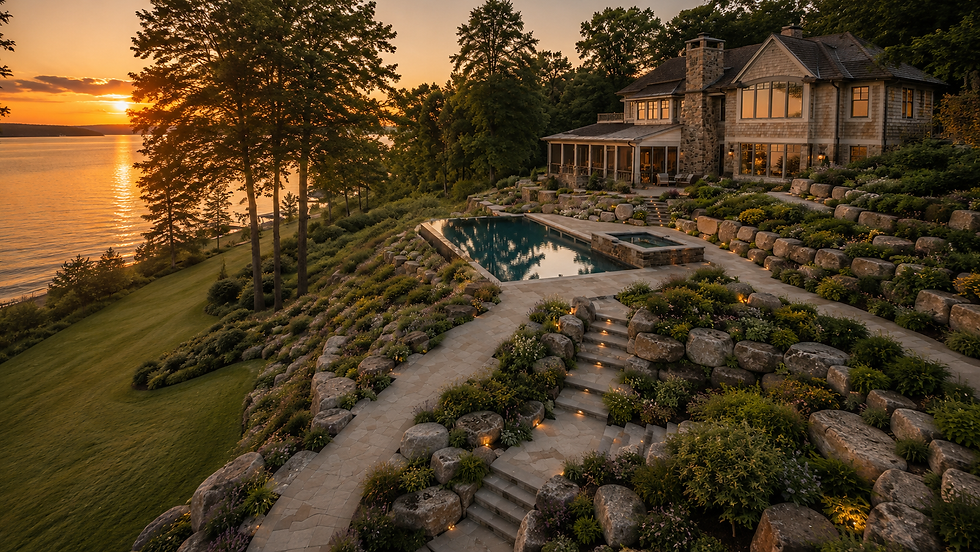
A boulder wall can help define a patio, support a pool terrace, frame a fire pit area, create planting beds, guide movement through the yard, or make a steep property more usable.
On a sloped lakefront lot, that can completely change how the outdoor space functions.
Instead of one steep yard that is hard to use, the property can become a series of connected outdoor rooms:
A patio near the house
Stone steps leading down through planting
A pool terrace
A fire pit area
A path toward the water.
The wall becomes part of the design, not just a construction detail.

Boulder walls pair beautifully with natural stone patios
One of the reasons boulder retaining walls are such a strong fit for Serene Stonescapes projects is how well they pair with natural stone patios.
Bluestone, limestone, granite steps, flagstone, and natural stone coping all work beautifully with boulder walls. Together, they create an outdoor space that feels timeless and grounded.
This is especially important for high-end homes and lakefront properties.
A manufactured wall block may function well, but it can sometimes feel too rigid or suburban for a Northern Michigan lake home. Boulder walls have a softer, more natural presence. They work with the land instead of visually fighting it.
When a boulder wall connects to a natural stone patio, stone steps, planting, lighting, and a pool or outdoor kitchen, the whole space feels more intentional.
Creating usable space on sloped yards
Many Traverse City and Leelanau County properties have grade changes.
That slope can be beautiful, but it can also limit how much of the yard is actually usable.
A boulder retaining wall can help create level areas for:
Patios
Pool decks
Outdoor kitchens
Fire pits
Dining spaces
Garden paths
Stone steps
Planting beds
Seating areas
This is one of the biggest benefits of a retaining wall. It can turn awkward or unusable grade into a place where people actually want to spend time.
For example, a sloped lakefront yard may not have enough flat space for a patio. By carefully cutting into the grade and supporting it with boulder walls, the property can gain a comfortable outdoor living area without making the design feel forced.
The goal is not to flatten the entire yard.
The goal is to shape the land in a way that feels natural and useful.
Boulder walls around pools and spas
Pools and spas often need thoughtful grade planning, especially on lakefront or hillside properties.
A pool needs to sit at the right elevation. The patio needs to drain correctly. The equipment needs to be accessible. The space around the pool needs to feel comfortable and connected to the house.
On sloped properties, boulder retaining walls can help make that possible.
They can support the pool terrace, soften elevation changes, frame planting areas, and create a more natural transition between the pool and the surrounding landscape.
A pool placed into a hillside with boulder walls, stone steps, native-style planting, and natural stone patio materials can feel much more connected than a pool surrounded by a flat, generic deck.
That is the difference between simply installing a pool and designing a complete outdoor environment.
Stone steps and transitions matter
A boulder retaining wall is only one part of the outdoor space.
The transitions are just as important.
How do you move from the house to the patio?
How do you get from the pool to the fire pit?
How does the path lead toward the lake?
Where do steps feel natural?
Where does lighting need to be added?
Where should planting soften the stone?
Stone steps can help the design feel intentional instead of chopped up. They guide people through the landscape and make grade changes feel comfortable.
On Northern Michigan properties, natural stone steps often feel more appropriate than plain concrete stairs. They pair beautifully with boulder walls and patios, and they help the entire space feel more custom.
A good design does not just solve elevation. It creates a journey through the property.
Drainage is the hidden detail that matters most
The most beautiful boulder wall still needs to be built correctly.
Drainage is one of the most important parts of any retaining wall project. Water needs somewhere to go. If it builds up behind a wall, it can create pressure and long-term problems.
A properly built boulder wall may include excavation, compacted base material, drainage stone, geotextile fabric, backfill, and drain tile depending on the wall, soil, slope, and site conditions.
These are the details most homeowners do not see when the project is finished.
But they are what help the wall perform over time.
In Northern Michigan, where spring thaw, heavy rains, and freeze-thaw cycles are part of life, drainage should never be an afterthought.
Permits and soil erosion considerations
Depending on the location and scope of the project, a boulder retaining wall may require permits or review.
This is especially true for lakefront properties, steep slopes, wetlands, drainage areas, or projects with significant soil disturbance.
In Grand Traverse County, Leelanau County, and nearby communities, soil erosion, zoning, land use, and building requirements can vary by property and municipality. A small garden wall on a flat lot is very different from a large boulder retaining wall on a lakefront slope.
That is why it is smart to talk about permitting early.
A good design should consider the wall location, height, drainage, access, slope, setbacks, and relationship to other project elements before construction begins.
Why design should come before construction
A boulder retaining wall is not something that should be guessed in the field without a plan.
The wall affects the grade, patio elevation, steps, drainage, planting, views, and overall flow of the outdoor space.
This is why design matters.
A site plan or 3D landscape design can help homeowners understand how the wall fits into the bigger picture. It can show the relationship between the house, patio, pool, outdoor kitchen, fire pit, steps, planting, and lake views.
This is especially helpful on sloped properties where elevation changes are hard to picture.
The goal is to make sure the finished space feels connected before construction starts.

When a boulder wall is the right choice
A boulder retaining wall may be a good fit if your property has:
a sloped yard
lakefront grade changes
a patio that needs support,
pool or spa on a hillside
a need for stone steps or terraces
erosion concerns
drainage challenges
or a desire for a natural Northern Michigan look
It may also be a strong choice if you want the outdoor space to feel more custom, timeless, and connected to the property.
Boulder walls are not the right answer for every project, but when they fit, they can completely transform a yard.
A natural fit for Traverse City outdoor living
For many Traverse City and Northern Michigan homes, boulder retaining walls are one of the most useful and beautiful hardscape elements available.
They help shape the land.
They create usable space.
They pair with natural stone patios.
They support pools and outdoor kitchens.
They make slopes easier to move through.
They feel connected to the landscape.
Most importantly, they help turn a challenging property into a more livable one.
At Serene Stonescapes, we design and build boulder retaining walls, natural stone patios, stone steps, pool patios, outdoor kitchens, and complete outdoor living spaces across Traverse City and Northern Michigan.
If your property has slope, lake views, or grade changes, a boulder wall may be one of the best ways to bring the whole outdoor space together.


Comments